
Minimum Wage Changes Across Canada in 2025 Throughout 2025 several provinces and territories across Canada have announced or implemented increases to their minimum hourly wages. These changes are largely driven by rising inflation and increasing cost of living. Governments are adjusting minimum hourly rates to help workers maintain some purchasing power. The increases vary from modest adjustments to more substantial bumps. The differences depend on local economic conditions and cost pressures. Government policies also play a role in determining the size of these wage increases. Each region faces unique economic challenges that influence how much wages need to rise. Some areas have seen sharper increases in housing costs and everyday expenses. Others have experienced more moderate price growth.

The higher wage thresholds are designed to give low-wage employees a better starting pay that matches inflation. This applies to part-time workers and full-time workers as well as casual employees and some workers in special categories. The new thresholds also encourage employers to adopt fairer pay practices.

Canada’s 2025 Minimum Wage Changes: A Complete Guide Here is a detailed breakdown of the new hourly minimum wages by province and territory for 2025. This guide covers the effective dates & explains what these changes mean for different types of workers across Canada.
Canada’s 2025 Hourly Wage Map: Province-Wise New Rates Explained
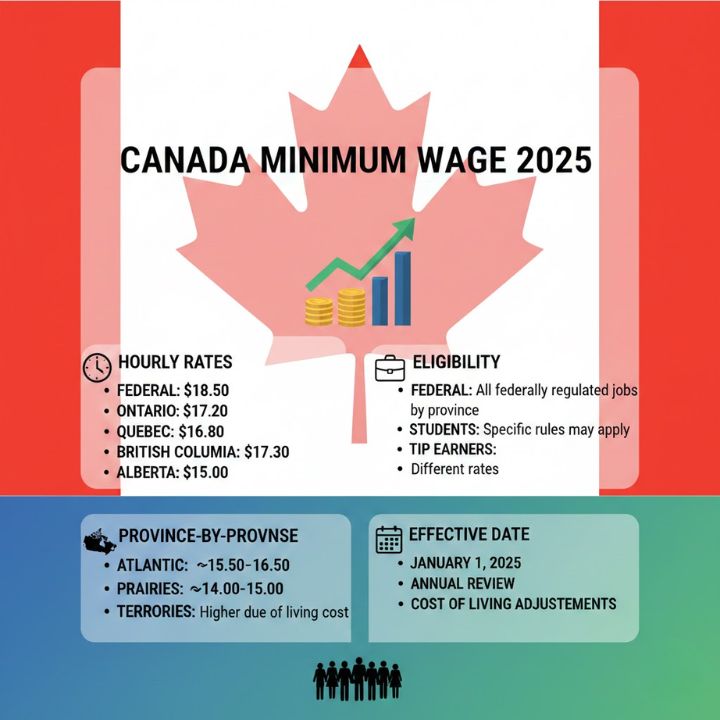
Here is a table showing the current minimum hourly wages for each province and territory in 2025. The information includes the wage amounts and when they took effect. Each jurisdiction sets its own minimum wage rate. The table displays the most recent figures available for all Canadian provinces and territories. These rates represent the latest updates that have been implemented or announced by regional governments. The minimum wage varies significantly across the country. Some areas have higher rates due to cost of living differences while others maintain lower rates.
 Canada Lines Up 6 CRA Payments Before Christmas 2025 - Revised Deposit Dates and Updated Timelines

| Province / Territory | 2025 Minimum Hourly Wage (CAD) | Effective Date / Notes |
|---|---|---|
| Nunavut | $19.75/hr | September 1, 2025 |
| British Columbia | $17.85/hr | June 1, 2025 |
| Ontario | $17.60/hr | October 1, 2025 |
| Yukon | $17.94/hr | April 1, 2025 |
| Manitoba | $16.00/hr | December 21, 2025 |
| Prince Edward Island (PEI) | $16.50/hr | December 21, 2025 |
| Nova Scotia | $16.50/hr | After October 1, 2025 |
| Newfoundland & Labrador | $16.00/hr | From April 1, 2025 |
| New Brunswick | $15.65/hr | From April 1, 2025 |
| Saskatchewan | $15.35/hr | October 1, 2025 |
| Alberta | $15.00/hr | No increase reported for 2025 |
| Northwest Territories | $16.95/hr | September 1, 2025 |
| Quebec | $16.10/hr | May 1, 2025 |
Note: The figures listed represent standard minimum wage rates only. Several provinces and territories apply different wage levels for specific groups such as students, tipped employees, homeworkers, seasonal workers, part-time staff, and other special categories.
Key Highlights
– Higher wages in remote and high-cost regions: Nunavut leads all regions with a minimum wage of $19.75 per hour, largely due to its high cost of living. British Columbia, Yukon, and Ontario also rank among the highest provinces and territories for base hourly minimum wages.
– Moderate adjustments in central provinces: Manitoba, Prince Edward Island, and Saskatchewan have introduced measured wage increases, indicating a gradual response to inflationary pressures and rising living expenses.
– No change in select regions: Alberta stands out in 2025 for maintaining its minimum wage at $15.00 per hour, showing no increase despite continued growth in overall living costs.
Eligibility Breakdown: Who Qualifies, Who Doesn’t, and Special Wage Categories
General Employees
Across all provinces, the general minimum wage applies to the majority of workers employed in provincially regulated workplaces. This rate covers full-time, part-time, casual, hourly, salaried, and commission-based employees. It typically includes workers in sectors such as retail, hospitality, customer services, administrative roles, manual labour, and other standard occupations.
Special Worker Categories
Certain provinces set different minimum wage rates or rules for specific groups of workers, including:
– Students (usually under 18 and working part-time while in school): For instance, Ontario applies a lower student minimum wage compared to the general rate.
– Homeworkers / remote workers: In Ontario, employees who perform their work from home are subject to a distinct minimum hourly wage, which is often higher to reflect limited access to traditional workplace benefits.
– Seasonal, part-time, or gig workers: In industries that operate seasonally or rely on tips, such as hospitality, provinces may enforce adjusted wage structures or additional regulations based on local labour laws.
Federal vs. Provincial Jurisdiction
In federally regulated industries such as banking, airlines, telecommunications, communications, and postal services, minimum wage rules can differ from provincial standards. These sectors may be governed by a distinct federal minimum wage instead of provincial rates.
As a result, employees should confirm whether their employer falls under federal or provincial regulation to determine which minimum wage legislation applies to their job.
Real-World Impact: How the 2025 Wage Hike Affects Employees and Businesses
Improved Base Pay, Yet Ongoing Pressure
Higher take-home income: For full-time minimum-wage workers (around 40 hours per week), the new rates translate into a clear rise in monthly earnings. In a province with a $17.60/hour minimum wage, workers will now take home more than under the previous rate. Estimates from the 2025 Ontario increase suggest a full-time employee could gain roughly CAD 835 more per year.
Partial relief against rising costs: With living expenses such as rent, groceries, utilities, and transportation continuing to climb, the wage increases offer some breathing room for low-income earners, helping them manage everyday expenses a little more easily.
Still below a true living wage: Even after the hikes, minimum wage levels in many provinces remain short of what is considered a “living wage” — the amount needed to comfortably cover essentials like housing, healthcare, transportation, childcare, and food. As a result, many workers may still struggle to save or achieve long-term financial stability.
For Employers: Adapting to Rising Labour Costs
Higher payroll obligations: Businesses that depend heavily on minimum-wage workers—such as those in retail, hospitality, and service industries—will experience increased wage expenses. For small employers, this may require revising budgets, adjusting prices, cutting back on staff hours, or reassessing workforce needs.

Stronger compliance and documentation requirements: Employers must verify that every worker—whether full-time, part-time, casual, piece-rate, or salaried—meets minimum wage standards when calculated on an hourly basis. This involves careful salary-to-hour calculations, overtime tracking, and proper handling of special employee categories like students and homeworkers.
Changes to hiring strategies and pay structures: With a higher wage floor, employers may rethink entry-level recruitment, explore automation, or redesign job roles to maintain financial sustainability—potentially influencing overall employment patterns and labour market dynamics.
Bigger Picture: Economic Pressures, Living Costs, and Social Implications
Inflation Trends, Living Expenses, and Wage Framework
The 2025 wage increases reflect ongoing inflation and higher living costs across many parts of Canada. Several provinces now link minimum wage adjustments to measures like the consumer price index or CPI. This approach helps wage growth match inflation rates and prevents low-income workers from losing their buying power over time.
Provinces with high living costs or harsh climates like remote areas sometimes need higher minimum wages to cover basic living expenses. These wages reflect the economic reality of those regions including housing costs and expenses for heating and transportation. This is why remote territories often set their minimum wages significantly higher than other areas.
Minimum Wage vs Living Wage and Income Reality
Despite recent increases, a noticeable gap still exists between statutory minimum wages and the income actually required to meet basic living needs. A true “living wage” accounts for essential expenses such as rent, food, childcare, transportation, healthcare, and modest savings. Advocacy organizations continue to stress that minimum wage levels must more closely align with real-world living costs, particularly in high-expense urban regions.
Advancing Fair Pay Across Low-Wage and Vulnerable Sectors
Minimum wage hikes strengthen financial protection for workers in traditionally underpaid sectors, including retail, hospitality, personal services, janitorial roles, and care work. Labour advocates view these increases as an important step toward fairness, poverty reduction, and improved economic stability for vulnerable and marginalized workers.
Beyond individual benefits, these policy changes reinforce the message that fair wage standards are a collective responsibility. They encourage employers and policymakers to treat adequate pay as a foundational social obligation rather than a discretionary practice.
Action Steps for 2025: What Workers and Employers Should Do Next
If You Are a Worker
– Verify the current minimum wage in your province or territory — stay informed about the officially approved hourly rate and the exact date the increase became effective.
– Ensure your earnings meet legal standards — regardless of whether you work part-time, full-time, casual, salaried, commission-based, or in the gig economy, your calculated hourly pay must meet or exceed the minimum wage.
– Learn about special wage categories — students, homeworkers, apprentices, and other specific employment groups may be subject to different minimum wage rules, so confirm what applies to your situation.
– Leverage wage increases for negotiation — if you are on a fixed salary or commission structure and your pay hasn’t been updated after a minimum wage hike, consider requesting a compensation review or raise.
If You Are a Worker
• Verify the current minimum wage in your province or territory — stay informed about the officially approved hourly rate and the exact date the increase became effective.
• Ensure your earnings meet legal standards — regardless of whether you work part-time, full-time, casual, salaried, commission-based, or in the gig economy, your calculated hourly pay must meet or exceed the minimum wage.
• Learn about special wage categories — students, homeworkers, apprentices, and other specific employment groups may be subject to different minimum wage rules, so confirm what applies to your situation.
• Leverage wage increases for negotiation — if you are on a fixed salary or commission structure and your pay hasn’t been updated after a minimum wage hike, consider requesting a compensation review or raise.
Final Verdict: A Positive Shift, But Not a Complete Solution
The 2025 minimum wage increases across Canada show meaningful progress toward fairer pay and address rising living costs. For many workers these increases will provide modest but welcome relief particularly for those in entry-level and low-wage positions.
For most workers minimum wage serves as just a starting point. In many provinces & territories it does not cover the actual costs of living comfortably. This problem becomes more serious in expensive regions or for families with children. A single hourly wage rate across the board cannot solve the differences in living costs between areas. Housing prices vary widely from one region to another. Transportation expenses differ depending on location. Childcare costs can take up a large portion of family budgets in some places while being more affordable in others.
These regional differences mean that the same minimum wage buys very different standards of living depending on where someone lives.